
Running tourism well is hard enough already.
Margins are tight before you factor in anything else. Seasonality means months of feast funding months of famine. Commissions to OTAs eat 15 to 20 per cent of the bookings you don't get directly. Most operators we talk to have spent years just getting the unit economics to work.
Consumer law doesn't stand still while you do that. It keeps evolving, whether you notice the change or not. Two changes are landing in the next twelve months that you need to know about:
- The Reserve Bank's card surcharge ban takes effect 1 October 2026.
- The Competition and Consumer Amendment (Unfair Trading Practices) Act 2026 passed Parliament in July 2026 and applies from 1 July 2027.
First, the good news
From 1 October 2026, surcharges on eftpos, Mastercard and Visa transactions are banned. No more passing card processing costs to the customer at the terminal or checkout.
Worth noting: American Express sits outside the RBA's designated networks, so it isn't covered by this rule directly. Amex has separately said it will stop surcharging too, but that's Amex's own call.
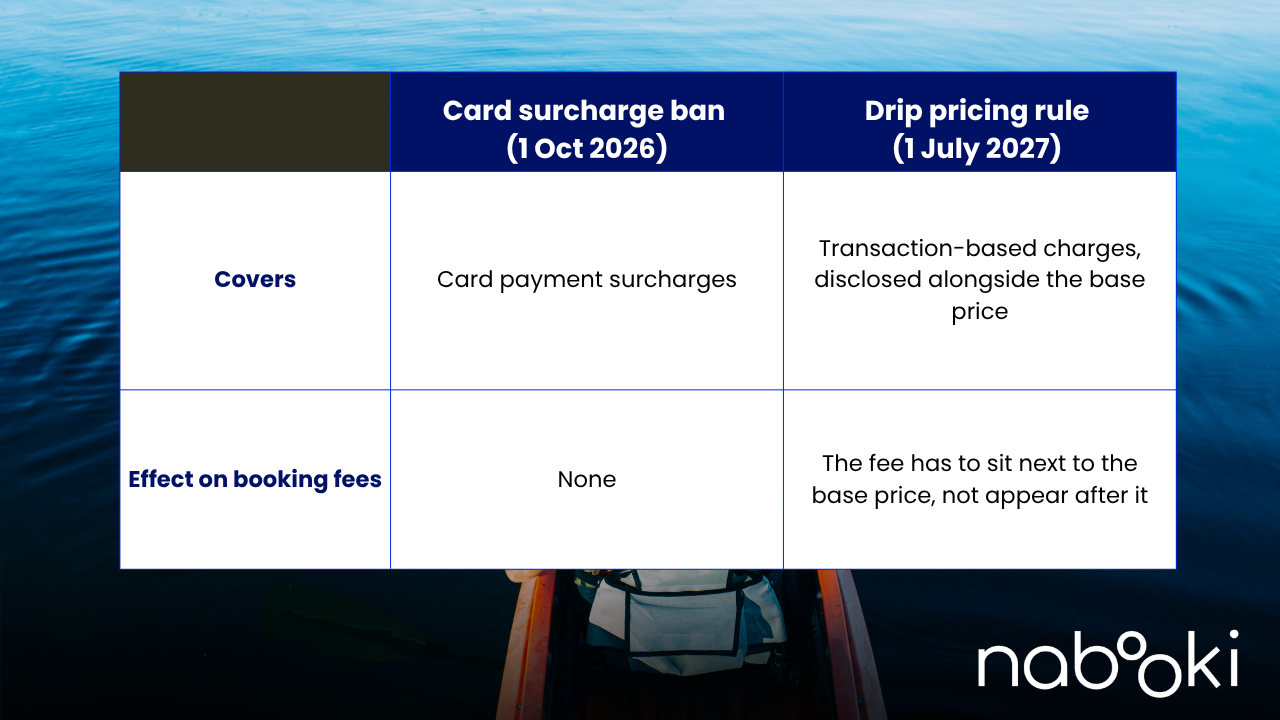
A lot of operators have looked at that date and assumed the booking fee disappears with it. It doesn't. The RBA has been direct about this: the changes apply to card surcharges only. Booking fees and service fees are explicitly out of scope, provided they apply regardless of payment method. Charge it only on card payments and it's a surcharge wearing a hat, which is banned. Charge it on every booking and it's a genuine service fee, which survives.
The change that matters: the Unfair Trading Practices Act
The amendment to the Unfair Trading Practices Act introduces a purpose-built anti-drip-pricing rule. Where you display a base price, you now have to disclose any mandatory transaction-based charge clearly and proximately alongside it, not several screens later at checkout.
It sits on top of an existing obligation under section 48 of the Australian Consumer Law, which already requires a single all-inclusive price to be shown at least as prominently as any component of it. Section 48 is already in force today. The new Act adds a specific disclosure rule for per-transaction fees, and a much larger penalty regime behind it.
The ACCC has already tested the underlying "show the real price early" principle under the general misleading conduct provisions.
Webjet copped a $9 million penalty for advertising airfares without compulsory fees. Dendy Cinema was hit with a $19,800 infringement notice for not showing a total price including a mandatory booking fee early enough in the flow. And back in 2015, Jetstar was taken to the Federal Court over an undisclosed $8.50 Booking and Service Fee, with Virgin pursued over a $7.70 equivalent in the same action.
What changes on 1 July 2027 isn't whether the fee is legal. It's how visible it has to be, and how much bigger the penalty is if it isn't.
A new disclosure standard
The confirmed requirement is a disclosure standard: transaction-based charges must be shown clearly and proximately, wherever the base price is shown.
Whether that forces the very first number a guest sees to already be the all-in total, or whether a fee shown clearly next to the base price on the same screen satisfies it, is unclear until we see final ACCC guidance or test cases. Both readings point to the same practical advice below.
What this means for the free-booking-software model
Here's the model a lot of operators are on with their booking software: no monthly fee, no setup cost, the platform takes a percentage at checkout, and the guest pays it. The pitch works because the operator's margin looks untouched.
The exposure isn't with the software provider. Section 48 already attaches liability to whoever represents the price to the consumer. That's the business whose name is on the tour, not the platform underneath it. Most provider terms already say this explicitly.
Under the new disclosure standard, that model gets harder to run cleanly. If the transaction fee has to sit alongside the base price rather than appear later in the flow, "From $100" stops being a defensible headline if $106 is what most guests actually pay. Depending on how "proximate" is ultimately interpreted, that could mean anything from a clearly visible fee line next to the price, through to the headline number itself needing to be the all-in total.
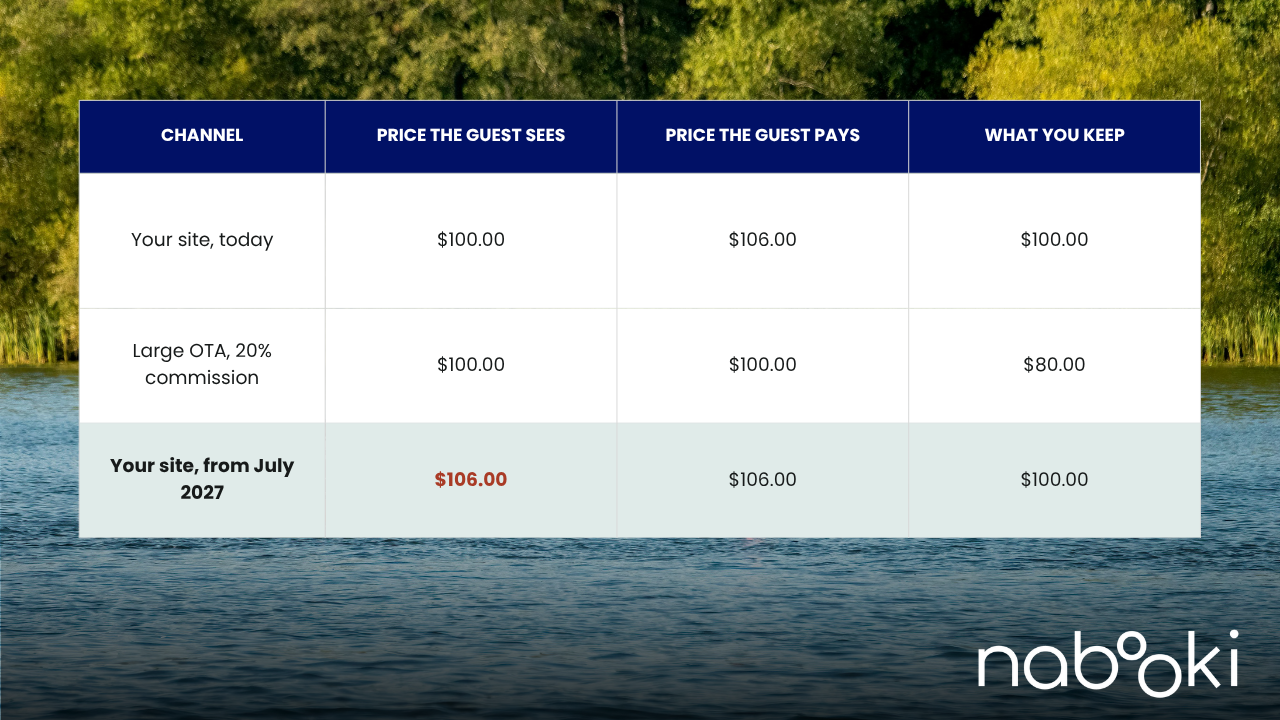
There's a competitive wrinkle here worth naming. On a straight side-by-side price comparison, a direct booking with a disclosed $6 fee can look more expensive than an OTA listing that's absorbed its 20 per cent commission into a "no extra fees" headline price, even though the operator nets more from the direct booking every time. Guests aren't generally comparing net margins. They're comparing two numbers on two screens.
What to do now
- Audit your own checkout. On a phone, in a private browser window, starting from your homepage. Note the first price shown and the number on the payment screen. If they differ, that's a problem today under section 48, not a 2027 problem.
- Find the indemnity clause in your booking provider agreement. Check who's responsible for consumer law compliance and price display, and whose name carries the exposure.
- Ask your provider, in writing: can the platform show a clear, proximate fee disclosure, or an all-inclusive price if you want to go further, as the guest's first price, well before 1 July 2027? Get the answer in writing.
- Cost out the direct channel properly. Compare the full cost of running direct bookings against OTA commission, not just the size of a software invoice.
- Consider moving early. Operators who adopt clear pricing disclosure ahead of the deadline get to market it as transparency. Operators who wait until June 2027 are reacting under pressure.
This article is general information, not legal advice. Whether a particular checkout complies with section 48, or whether a specific fee is caught by the new transaction charge rules, depends on facts a lawyer needs to look at directly. Dates and figures current as at 21 September 2026.
